algorithmic-pattern-explorer
Algorithmic Pattern Explorer
An educational application that visualises generative algorithms to teach computational thinking through interactive pattern exploration.
Overview
Algorithmic Pattern Explorer is an educational web application developed as part of an MSc dissertation investigating how interactive visualisation can support the learning of computational thinking through generative art.
The application presents generative algorithms as interactive visual workflows, allowing learners to inspect, manipulate and step through each computational stage. Rather than programming algorithms themselves, users explore how parameterised operations transform intermediate representations into final patterns, supporting understanding of computational thinking concepts through visual explanation.
Research Questions
Primary Research Question
How can interactive visualisation of generative algorithms support understanding of computational thinking concepts through pattern creation?
Secondary Research Question
How do different generative logics influence the emergence of visual structure across a spectrum from stochastic to deterministic systems?
Educational Objectives
The application is designed to help learners develop an understanding of computational thinking through direct interaction with generative systems.
Key concepts include:
- Randomness
- Iteration
- Transformation
- Symmetry
- Rule-based generation
- Parameterisation
- Emergence
- Procedural modelling
- Computational creativity
Rather than simply generating patterns, the application aims to explain why different algorithms produce different visual behaviours.
Generative Spectrum
The project investigates four generators representing increasing levels of algorithmic constraint.
| Generator | Computational Approach | Position on Spectrum |
|---|---|---|
| Perlin Noise | Controlled randomness | Stochastic |
| Voronoi Diagrams | Random inputs with deterministic partitioning | Hybrid |
| Escher Tessellations | Geometric transformations | Structured |
| Islamic Geometric Patterns | Mathematical construction rules | Deterministic |
Together these demonstrate how different computational rules influence pattern formation.
Educational Interface
The core contribution of the project is an interactive algorithm explorer.
Instead of exposing only parameter controls, each generator is represented as a visual workflow composed of algorithmic stages.
Users can:
- Explore the structure of each algorithm
- Manipulate parameters at individual stages
- Observe live updates to generated patterns
- Learn the computational concepts represented by each operation
- Compare stochastic and deterministic approaches
The educational interface transforms procedural generation from a hidden implementation into an explorable learning experience.
Design Evolution
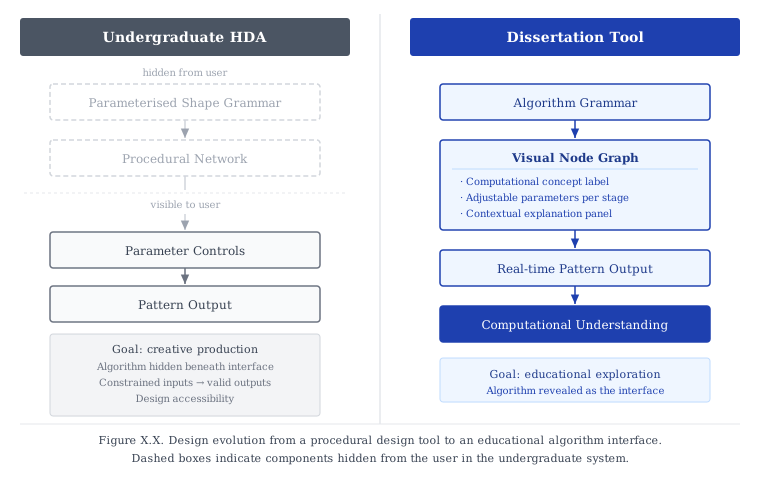
This interface design builds directly on a previous undergraduate R&D project: an Islamic geometric pattern generator implemented as a Houdini Digital Asset (HDA). That system used parameterised shape grammars to drive pattern generation, but kept the procedural graph hidden — users interacted only with a curated parameter panel, and could produce valid outputs without understanding the computational process behind them.
The dissertation inverts this approach. Rather than abstracting the algorithm away, the node-based workspace surfaces it as the primary learning object. The shift is from design accessibility to educational accessibility — from helping users use a procedural tool, to helping them understand how one works.
Minimum Viable Product
Pattern Generators
- Perlin Noise
- Voronoi Diagrams
- Escher-inspired Tessellations
- Islamic Geometric Patterns
Algorithm Explorer
- Interactive visual workflow
- Custom algorithm nodes
- Stage-by-stage parameter editing
- Live pattern updates
- Educational explanations for each computational concept
Export
- PNG export
- SVG export (where supported)
Target Audience
The application is intended for:
- Students learning programming and computational thinking
- Learners exploring generative art
- Creative coders
- Designers interested in procedural workflows
- Educators teaching algorithmic concepts through visual media
Evaluation
The project will be evaluated through user testing focusing on:
- Usability
- Learning experience
- Understanding of computational concepts
- Understanding of algorithmic workflows
- Relationship between parameter changes and visual outcomes
- Perceived educational value
Technical Architecture
The application is built using a modular architecture that separates pattern generation from educational visualisation.
Core design principles include:
- Reusable generator architecture
- Modular parameter system
- Interactive node-based algorithm visualisation
- Extensible educational content
- Real-time procedural rendering
- Vector and raster export
Future Work
The current MVP focuses on helping users explore and understand predefined generative algorithms through an interactive visual interface. Several extensions could further develop the application into a richer educational platform.
Grammar-Based Pattern Construction
A natural progression of the algorithm explorer would be to support user-created generative workflows. Rather than interacting with predefined algorithms, learners could construct their own pattern generators by composing reusable computational operations.
Drawing inspiration from shape grammars, tree grammars, and functional combinators, each visual node could represent a modular rule such as:
- Generate Grid
- Apply Symmetry
- Repeat
- Rotate
- Mirror
- Subdivide
- Add Randomness
- Render
Users could connect these operations to create new procedural workflows while learning how complex algorithms emerge from simple computational building blocks.
Interactive Algorithm Authoring
The current visual workspace is designed as an educational algorithm explorer. Future versions could evolve into a guided authoring environment, allowing users to experiment with their own computational rules while maintaining valid graph structures through predefined constraints and validation.
This approach would encourage learners to transition from understanding existing algorithms to designing their own procedural systems.
Guided Learning Pathways
Additional educational content could include:
- Step-by-step tutorials
- Interactive programming exercises
- Progressive difficulty levels
- Classroom lesson plans
- Self-assessment activities
Additional Generative Systems
Future versions could introduce further procedural techniques for comparison, including:
- L-Systems
- Reaction–Diffusion Systems
- Cellular Automata
- Fractal Generation
- Agent-Based Systems
These additions would broaden the range of computational paradigms available for exploration while reinforcing the project’s objective of making generative algorithms accessible through interactive visual learning.
Project Status
🚧 Active MSc Dissertation Project
Current development is focused on:
- Implementing the four core generators
- Building the React Flow algorithm explorer
- Developing the educational layer
- Designing and conducting user evaluation